
Fares Rose 4.6% in January. Your Delay Repay Rights Rose With Them.
Every January, your season ticket costs more. What most commuters don't realise is that their Delay Repay entitlement on every qualifying delay also increases by the same percentage — automatically. Here is what the updated maths looks like.
Rail Repay Podcast
Fares Rose 4.6% in January. Your Delay Repay Rights Rose With Them.
Enjoy the related dialogue — a two-voice conversation on this topic.
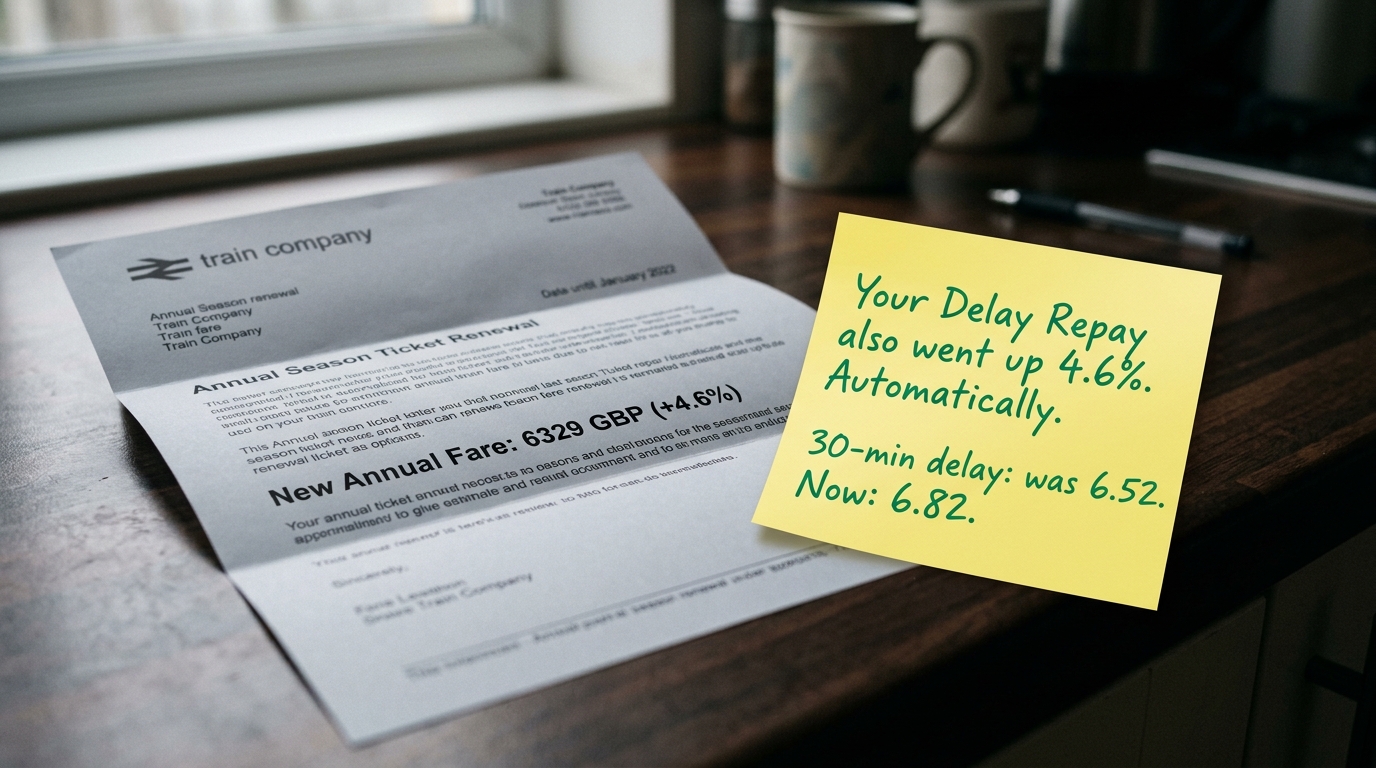
January. The renewal notice arrives — or, more likely, the direct debit simply increases without ceremony. This year's regulated fare rise: 4.6%. Your Colchester to Liverpool Street annual season ticket, which cost £6,050 last year, now costs approximately £6,329.
You paid it because you need to get to work.
What the announcement did not say — what it never says — is that your Delay Repay entitlement increased on the same day. Automatically. By the exact same percentage. With no action required from you.
Every £ you now overpay in fares comes with a proportionally larger entitlement when things go wrong.
The Automatic Increase
Delay Repay compensation is calculated as a percentage of the fare you paid. When the fare goes up, the compensation goes up proportionally. There is no form to fill in, no opt-in required, no notification from Greater Anglia. It happens automatically, because the calculation is tied to the ticket price — and the ticket price just increased by 4.6%.
The updated numbers for the Colchester to Liverpool Street route:
| Metric | 2025-26 (£6,050) | 2026-27 (£6,329) |
|---|---|---|
| Single-leg value (÷464) | £13.04 | £13.64 |
| 15–29 min delay (25%) | £3.26 | £3.41 |
| 30–59 min delay (50%) | £6.52 | £6.82 |
| 60–119 min delay (100%) | £13.04 | £13.64 |
| 120+ min delay (return) | £26.08 | £27.28 |
The per-claim increase is modest. But multiply across a full year of qualifying delays: fifteen claims at the new rate versus the old rate adds approximately £5 to your annual recovery. Small. But automatic, and yours by right.
The Uncomfortable Equation
The fare rise was justified, as they always are, with reference to inflation, infrastructure investment, and the costs of running the network. These justifications may be valid. The point here is not to litigate them.
The point is this: ORR performance data for Greater Anglia does not show a corresponding improvement in punctuality. The fraction of services arriving late — by the strict, within-one-minute measure — has not declined meaningfully alongside successive fare increases. You are paying more for approximately the same service quality.
Which means you are also, mathematically, owed more on every delay. The compensation is not generosity from the operator — it is the automatic financial consequence of a higher-priced contract not being fully fulfilled.
Here is a figure that rarely gets quoted: the total value of unclaimed Delay Repay across UK rail passengers runs into the tens of millions of pounds annually, according to ORR consumer data. Fare rises quietly increase that unclaimed pool every January. The money does not disappear — it simply stays with the operator.
What to Do
If you use Rail Repay, update your ticket price to reflect the new fare. The compensation calculation adjusts accordingly. If you file claims manually, use the new season ticket cost when completing the Greater Anglia form.
The 28-day window applies to each delay. If you have a qualifying delay from the past four weeks that predates your fare increase, use the fare that applied on the date of travel.
A Note on Timing — and a Tip Worth £5
This article is published outside of January, but the underlying point is relevant year-round: whenever your fare changes, your compensation entitlement changes with it. An upgrade to a longer-distance season ticket, a switch from monthly to annual, a route change — all of these affect the calculation.
Always enter the price you currently pay. Not the price from last year's renewal. Not an estimate. The current fare.
One practical note: if you are filing a Delay Repay claim that spans a fare change date — for example, a delay that occurred in late December, claimed in January after the new fares took effect — use the fare that applied on the date of travel. The compensation is based on what you paid for that specific journey, not what you pay now.
When filing, select bank transfer as your payment preference. Payment typically arrives within five working days.
Check what you may be owed — free, no card needed — at railrepay.co.uk.
Sources:
- •Department for Transport Regulated Fare Increases 2026 — gov.uk
- •National Rail Conditions of Travel 2025, Clause 32 — nationalrail.co.uk
- •ORR Rail Performance Statistics Q4 2024-25 — orr.gov.uk
- •Greater Anglia Delay Repay — greateranglia.co.uk
Stop leaving money on the platform
Check what your Greater Anglia route may owe you — in 60 seconds
Free delay alerts + AI claim drafts. No card required. You stay the claimant.
You might also like


This article is informational and is not legal advice. See the legal basis and sources. The train company decides the final eligible amount after validating your ticket, journey, and delay evidence. Legal basis and sources