
One in Four: The Greater Anglia Punctuality Numbers They Don't Put on the Posters
ORR data shows Greater Anglia arrives on time in fewer than 3 out of 4 journeys. Behind the headline figures, the real picture is worse — and most passengers never see it.
Rail Repay Podcast
One in Four: The Greater Anglia Punctuality Numbers They Don't Put on the Posters
Enjoy the related dialogue — a two-voice conversation on this topic.
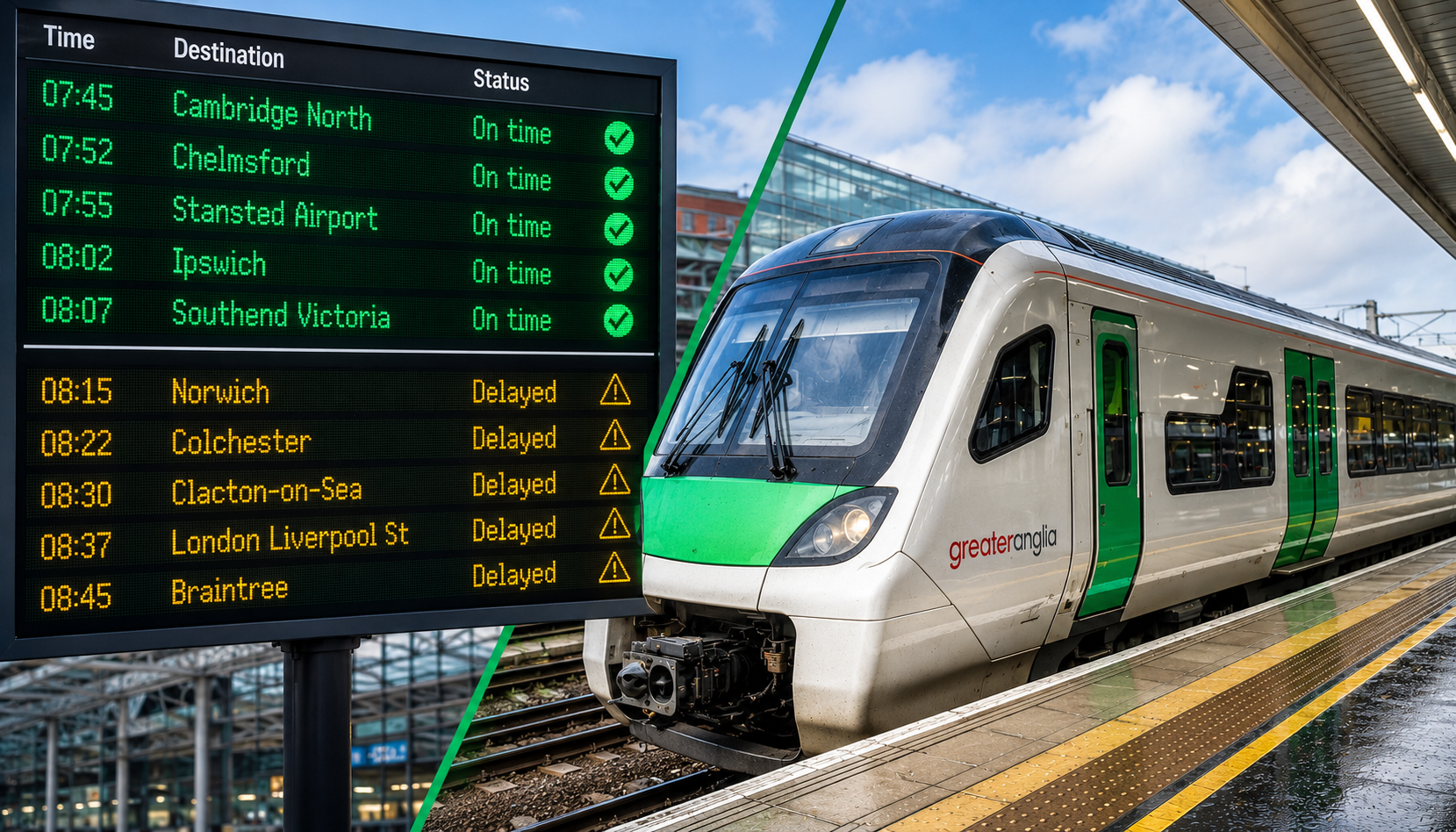
The departure board said "On time." It usually does, right up until it doesn't.
I looked it up properly once — sat on the train home, signal delay somewhere south of Chelmsford, phone in hand — and pulled up the actual ORR performance data. I had a rough idea things weren't great. I did not expect the numbers to be quite that clear.
What the Data Actually Shows
Every quarter, the Office of Rail and Road publishes performance statistics for every UK rail operator. These are not estimates. They are measured from real service data. And for Greater Anglia in 2024-25, the Right Time Arrivals figure — trains arriving within one minute of schedule — sat at around 73 to 78 percent, depending on the route and the quarter.
That means roughly one in four journeys does not arrive on time. Not within five minutes. Not within ten. Within one minute of when the timetable said it would arrive.
Sit with that for a moment. Every fourth morning commute, statistically, ends with you arriving later than scheduled.
The "On Time" Trick
Here is where it gets more interesting, and a little frustrating.
The headline performance figure most operators quote — the Public Performance Measure, or PPM — uses a different standard. A train counts as "on time" under PPM if it arrives within five minutes of schedule (ten minutes for long-distance services). This is the number you might see quoted in press releases or station announcements.
Which means a train arriving four minutes and fifty-nine seconds late is, officially, "on time."
That is not a conspiracy. It is just a definitional choice that happens to make the numbers look considerably better than they are. The ORR's Right Time measure is harder to spin. A minute is a minute.
What It Means for Your Compensation Rights
Greater Anglia runs the Delay Repay 15 scheme. Any journey arriving 15 minutes or more late at your destination may be eligible for compensation. The scale is straightforward:
- •15–29 minutes late: 25% of the single fare
- •30–59 minutes late: 50% of the single fare
- •60–119 minutes late: 100% of the single fare
- •120+ minutes or unable to travel: 100% of the return fare
ORR data suggests passengers on busy commuter routes may experience 15 or more qualifying delays per year. On a Colchester to Liverpool Street annual season ticket (£6,050 in 2025-26), that translates to somewhere between £75 and £200 in potential compensation, depending on the severity of the delays.
Most of it goes unclaimed.
The Gap Between What Happens and What Gets Claimed
There is a version of this story where Greater Anglia's performance is bad and passengers are owed a lot of money that they successfully recover. That would at least be a reasonably fair outcome.
The actual version is that the performance is poor, the money is legally available, and most of it quietly disappears anyway — because claiming takes effort, the 28-day window is strict, and by the time you remember to look into it, the frustration has faded.
Worth noting: if you are on an annual season ticket and wondering whether it is worth claiming smaller amounts — yes, it is. The 1/464 daily value of a £6,050 annual ticket works out to about £13 per single leg. A 30-minute delay means £6.50. Do that ten times a year and you have recovered £65. That is not nothing.
The Numbers Do Not Lie — But They Do Require Looking Up
The ORR publishes this data publicly. It is available at orr.gov.uk, updated quarterly, broken down by operator, route category, and time period. Greater Anglia's figures sit alongside every other operator in England and Wales. The comparison is not always flattering.
I am not writing this to say Greater Anglia is uniquely bad. The data is what it is, and most UK commuter routes share similar challenges. I am writing it because most passengers I speak to genuinely do not know their operator's punctuality rate. They have a vague sense that trains are often late. They have not seen the actual number.
Now you have.
One Practical Note
When you do file a Delay Repay claim with Greater Anglia, select bank transfer as your payment method rather than PayPal or a card refund. The money arrives directly in your account within five working days. Small thing. Worth knowing before you get to the end of the form.
The Takeaway
Around one in four Greater Anglia journeys does not arrive within a minute of schedule. A meaningful proportion of those qualify for Delay Repay compensation. The scheme exists, the rights are real, and the process — while not effortless — is manageable.
If your train was 15 minutes or more late in the last 28 days, you may be owed something back. Check the numbers, check your route, and check what you may be owed at railrepay.co.uk — free, no card needed.
The data is public. Might as well use it.
Sources:
- •ORR Rail Performance Statistics 2024-25 — orr.gov.uk
- •ORR Right Time Arrivals methodology — orr.gov.uk
- •Greater Anglia Delay Repay — greateranglia.co.uk
- •National Rail Conditions of Travel 2025 — nationalrail.co.uk
Stop leaving money on the platform
Check what your Greater Anglia route may owe you — in 60 seconds
Free delay alerts + AI claim drafts. No card required. You stay the claimant.
This article is informational and is not legal advice. See the legal basis and sources. The train company decides the final eligible amount after validating your ticket, journey, and delay evidence. Legal basis and sources